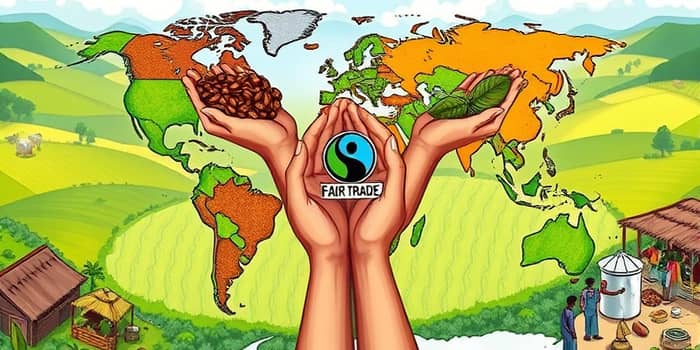
Imagine a world where every purchase you make echoes with justice, where the hands that grow your coffee or craft your clothes are treated with dignity and respect.
This is the vision of fair trade, a movement that transforms commerce into a game of equity versus inequality.
It challenges the conventional rules of global trade, inviting us to question whether it truly benefits marginalized communities or creates new barriers.
At its core, fair trade is more than just a label; it is a commitment to humanizing economic exchanges.
It emerged from grassroots efforts by NGOs, the UN, and social movements like pacifism and environmentalism.
These pioneers sought to forge voluntary and just relationships between producers in developing countries and consumers worldwide.
Their goal was to foster sustainable development that honors cultural traditions and human rights.
As we delve into this intricate game, we must explore its origins, principles, and the ongoing debate surrounding its impact.
Fair trade is defined by the World Fair Trade Organization (WFTO) as a trading system based on dialogue, transparency, and respect.
It aims for greater equity in international trade by focusing on social and environmental criteria.
This system contributes to sustainable development by offering better commercial conditions.
It ensures the rights of disadvantaged producers and workers, especially in the Global South.
The WFTO has established ten core principles that guide all actors in the fair trade network.
These principles form the backbone of a system designed to counteract exploitation.
They highlight a shift from profit-centric models to ones that value people and the planet.
The fair trade process involves a streamlined supply chain that minimizes intermediaries.
It starts with production by small-scale organizations in communities across Asia, Latin America, or Africa.
These groups often face marginalization in conventional markets.
Distribution is handled by importers who buy directly from producers, avoiding unnecessary middlemen.
This approach reduces margins to maximize benefits for the original creators.
Sales occur through specialized stores or ethical retailers that cater to conscious consumers.
Consumption is driven by individuals who choose products aligned with ethical, human, and ecological values.
Key characteristics include advance payments to prevent debt, emphasis on quality and sustainability, and transparent information for consumers.
This system fosters a direct connection between producers and consumers.
It empowers communities to thrive beyond mere survival.
Fair trade offers numerous advantages that extend from local economies to global ethics.
Economically, it provides price stability for vulnerable producers of crops like coffee and cocoa.
This stability allows for dignified living standards and reinvestment in community projects.
Socially, it ensures fair wages, eliminates child labor, promotes gender equality, and supports union rights.
Benefits are shared to foster local development and social cohesion.
Environmentally, it encourages eco-friendly practices such as sustainable agriculture.
This reduces the ecological footprint and preserves natural resources for future generations.
These benefits demonstrate how fair trade can be a powerful tool for positive change.
It inspires millions to participate in a more compassionate economy.
Despite its merits, fair trade faces criticisms that question its efficacy and scalability.
Some argue it does not address structural inequalities in global trade.
It may act as a temporary fix rather than a universal solution.
The use of minimum prices can create market distortions, potentially discriminating against non-certified competitors.
This might lead to protectionism or barriers to pure free trade.
Fair trade often relies on a niche market of ethically minded consumers.
Higher prices due to reduced margins or ethical intermediaries could exclude price-sensitive buyers.
Its scale is limited, covering only a fraction of global commerce.
Critics point out hypocrisy if it fails to address protectionism in wealthy nations.
These criticisms urge a balanced view, recognizing both achievements and shortcomings.
Fair trade operates in over 76 countries through the WFTO network.
However, quantitative data on global sales or poverty impact is often lacking in recent statistics.
This gap underscores the need for more research and transparency.
Efforts are ongoing to collect data on metrics like Fairtrade sales projections for 2025.
Such information can strengthen the debate and guide improvements.
This table highlights key differences, helping consumers make informed choices.
It illustrates how fair trade reshapes traditional commerce dynamics.
Fair trade presents a complex interplay of benefits and barriers.
It offers a beacon of hope for marginalized communities striving for justice.
Yet, it also faces challenges in scalability and systemic change.
As consumers, we hold the power to influence this game through our purchasing decisions.
By supporting fair trade, we champion ethical consumption and global solidarity.
We must continue to advocate for data-driven improvements and broader adoption.
Ultimately, fair trade is not just about products; it is about people and principles.
It invites us to play a role in creating a more equitable world.
Let us embrace this game with critical minds and compassionate hearts.
Together, we can turn commerce into a force for good.
Referencias